
Our Research Areas
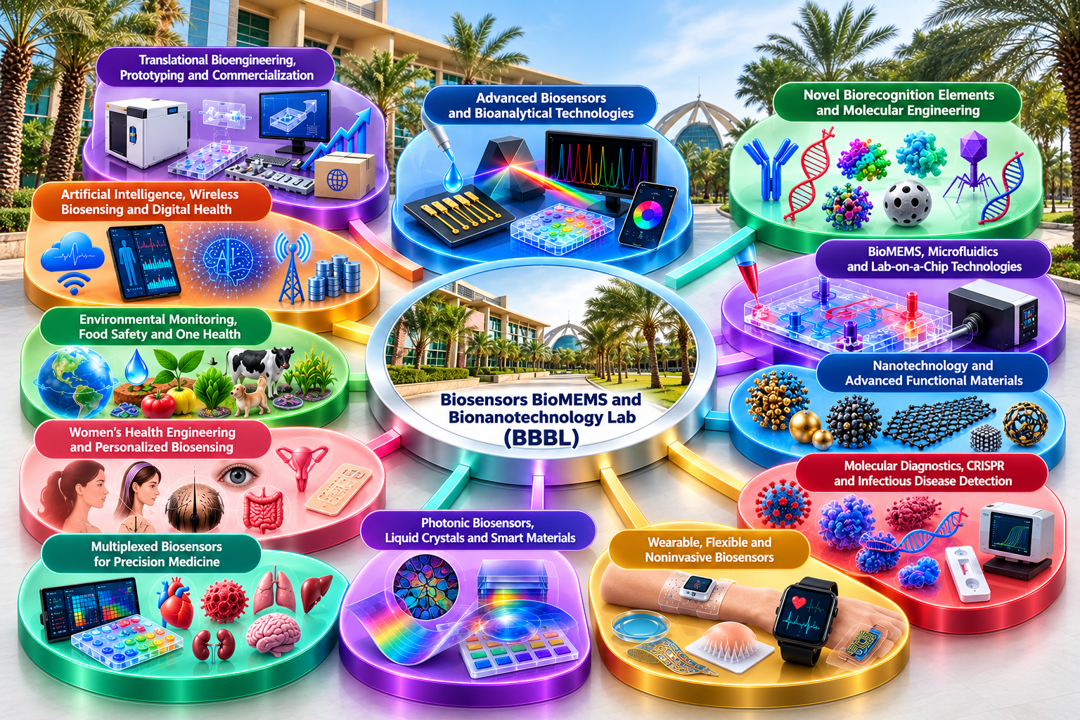
1. Advanced Biosensors and Bioanalytical Technologies
BBBL develops innovative biosensing platforms based on electrochemical, optical, photonic, fluorescence, colorimetric, plasmonic, and hybrid detection mechanisms. Our research encompasses the development of advanced sensing interfaces, novel signal transduction strategies, multiplexed detection architectures, and miniaturized analytical devices.
A major focus is improving analytical sensitivity, specificity, response time, operational stability, and affordability while enabling the detection of multiple molecular targets within a single integrated platform.
2. Novel Biorecognition Elements and Molecular Engineering
We investigate and engineer a wide range of biological and synthetic recognition elements, including antibodies, aptamers, enzymes, bacteriophages, phage-display-derived peptides, molecularly imprinted polymers, and nucleic-acid probes.
Our research emphasizes the discovery, selection, optimization, immobilization, and integration of recognition elements into advanced biosensing systems, enabling highly selective detection of proteins, metabolites, nucleic acids, pathogens, toxins, and other clinically or environmentally relevant targets.
3. BioMEMS, Microfluidics and Lab-on-a-Chip Technologies
BBBL designs and develops miniaturized biomedical microsystems and integrated lab-on-a-chip platforms that combine sample collection, purification, separation, concentration, molecular amplification, and biosensing within compact devices.
Our expertise includes microfluidic device engineering, ultrasonic and acoustofluidic technologies, microfabrication, microarray integration, and automated sample-to-answer systems.
These technologies aim to reduce sample consumption, reagent requirements, analysis time, and operator intervention while improving reproducibility and analytical performance.
4. Nanotechnology and Advanced Functional Materials
We develop and functionalize advanced nanomaterials to improve the performance of biosensors and bioanalytical systems.
Our research encompasses gold and other metallic nanoparticles, magnetic nanobeads, carbon nanomaterials, graphene-based materials, nanostructured electrodes, functional polymers, and hybrid nanocomposites.
These materials are employed for target capture, biomarker enrichment, signal amplification, surface functionalization, controlled molecular interactions, and improved biosensor performance. Additional applications include cell isolation, magnetic separation, and advanced biomedical technologies.
5. Molecular Diagnostics and Infectious Disease Detection
BBBL develops rapid and integrated molecular diagnostic technologies for detecting infectious agents and their molecular signatures.
Our research combines PCR, isothermal nucleic-acid amplification, CRISPR-based detection, microfluidics, nanotechnology, and electrochemical or optical readout systems.
Applications include bacterial and viral infections, emerging infectious diseases, sexually transmitted infections, antimicrobial resistance, and pathogen surveillance.
Our objective is to develop accurate, affordable, multiplexed, and field-deployable molecular diagnostic technologies suitable for centralized laboratories, point-of-care settings, and resource-limited environments.
6. Wearable, Flexible and Noninvasive Biosensors
We develop advanced wearable and minimally invasive sensing technologies for continuous and longitudinal monitoring of human health.
Our research integrates flexible electronics, electrochemical sensing, aptamer-based recognition, photonic materials, microneedle interfaces, and miniaturized microfluidic systems.
These platforms target biochemical and physiological markers in sweat, interstitial fluid, tears, saliva, and other accessible biological samples.
Applications include cardiovascular monitoring, metabolic health, inflammatory diseases, personalized medicine, and women's health.
7. Photonic Biosensors, Liquid Crystals and Smart Materials
BBBL investigates novel photonic sensing mechanisms and stimuli-responsive functional materials for developing optical and colorimetric biosensors.
A particular research interest is the development of cholesteric liquid-crystal sensing systems, functional polymer networks, and molecularly responsive photonic interfaces.
These technologies enable the conversion of molecular recognition events into measurable optical changes, supporting label-free detection, visual readout, smartphone-assisted analysis, and low-cost diagnostic applications.
8. Multiplexed Biosensors for Precision Medicine
We develop integrated multiplexed analytical platforms capable of simultaneously detecting panels of disease-associated biomarkers.
Our research addresses cardiovascular diseases, cancer, inflammation, metabolic disorders, organ transplantation, infectious diseases, and therapeutic response monitoring.
By combining multiple biomarkers within a single analytical system, we aim to improve disease characterization, early detection, patient stratification, longitudinal monitoring, and treatment assessment.
9. Women's Health Engineering and Personalized Biosensing
BBBL is advancing innovative bioengineering technologies addressing women's health across different life stages.
Our research explores wearable and noninvasive sensing systems for reproductive health, hormonal changes, skin and hair health, ocular health, intimate health, and gastrointestinal health.
These platforms combine multiplexed biochemical sensing, advanced microfluidics, smart functional materials, smartphone-based analysis, and artificial intelligence to support personalized monitoring and data-driven healthcare.
10. Environmental Monitoring, Food Safety and One Health
We develop innovative sensing technologies for monitoring biological and chemical contaminants in environmental, agricultural, food, and veterinary samples.
Target analytes include microbial pathogens, pharmaceutical residues, antibiotics, hormones, endocrine-disrupting chemicals, pesticides, plasticizers, and antimicrobial resistance markers.
Our research emphasizes portable, multiplexed, automated, and field-deployable sensing systems that support environmental protection, food quality assurance, public health surveillance, and One Health initiatives.
11. Artificial Intelligence, Wireless Biosensing and Digital Health
BBBL integrates advanced biosensing technologies with artificial intelligence, wireless communication, embedded electronics, smartphone interfaces, and connected data platforms.
Our research investigates machine-learning-assisted biosensor interpretation, multivariate biomarker analysis, personalized monitoring, and predictive analytical models.
By connecting physical biosensing technologies with intelligent digital systems, we aim to enable remote monitoring, automated decision support, and next-generation connected diagnostic networks.